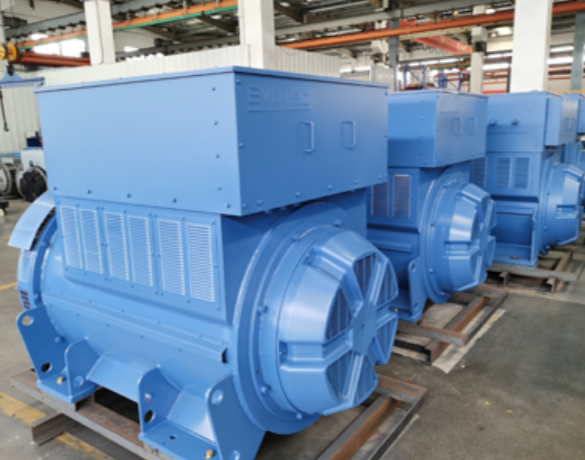
The decision to specify a certified 3000 kVA unit often comes down to where it must operate and how it will be tested — a comparative approach clarifies trade-offs immediately. For projects that straddle maritime and onshore grid roles, engineers commonly compare a 3 mw generator against larger alternatives to understand cooling, fuel management, and harmonics control in each environment. This article offers a precise comparison that senior technical buyers and project leads will find usable and relevant.
Comparative logic: what changes between ship and shore
Shipboard installations demand compact footprint and robust vibration isolation; onshore grid support favours extended run-times and ease of access for maintenance. Alternator coupling, transient response and enclosure class are the three technical axes that typically diverge. For example, a marine-skewed alternator will prioritise mechanical damping, while an industrial alternator for prime power emphasizes thermal margin and serviceability.
Key technical differences that determine performance
kVA rating alone does not guarantee fit. Cooling strategy (air-to-air vs. liquid), load bank testing frequency, and governor control type influence continuous output and fuel consumption. Synchronization capability becomes essential where parallel operation with grid or other gensets is expected; protections for reverse power and overcurrent must be specified to IEC sub-systems or equivalent manufacturer test routines. Practical terms: expect different enclosure IP rating, alternator winding insulation class, and transient response tuning between the two domains.
Compliance, testing and documentation — direct requirements
Compliance questions hinge on explicit test parameters rather than labels. For onshore grid connection, require a defined type test schedule: steady-state voltage regulation over a 60-minute loaded run, load rejection transient measured at specified step changes (e.g., 25% load step with recovery within 5 seconds), and harmonic distortion tests documented at 100%, 75%, and 50% load points. For maritime class approval, request vibration endurance tests at shaft frequencies, salt-fog enclosure verification for 96 hours per the supplier test plan, and an over-speed test with recorded governor response time. These precise checkpoints save redesign later.
Deployment case study: lessons from extreme grid strain
During the Texas winter storm of February 2021, many sites moved rapidly to bring remote generators online to sustain critical loads; units with clear synchronization procedures and proven cold-start strategies proved decisive. That real-world anchor illustrates the value of cold-cranking design, battery-heater provisions, and explicit load bank commissioning. Facilities that had performed recent load bank testing reported smoother activation and more predictable fuel consumption. The lesson: commissioning protocols matter as much as rated output.
Common specification mistakes and how to avoid them
Buyers often assume the largest kVA is the safest choice — this can lead to oversized electrical switchgear and unnecessary fuel logistics. Another frequent error is accepting generic test certificates without the sub-chapter detail that proves performance across the intended operating window. Insist on explicit parameters: duration and load profile of endurance tests, measurement points for harmonic analysis, and governor dead-band settings. Also include clear requirements for maintenance access and spare parts lead time; these reduce downtimes substantially — and they preserve budget predictability.
Comparing alternatives: when to consider a 4500 kVA generator
Some projects benefit from stepping up capacity to a 4500 kva generator to reduce the number of parallel sets and simplify switchgear. That trade-off affects footprint, initial capital, and synchronizing complexity. If continuous prime power is required with fewer transfer operations, the larger unit may be preferable. Conversely, modular smaller units give redundancy and staged maintenance windows.
Three golden rules for final selection
1) Specify measurable test parameters: list endurance run durations, load increments for transient tests, and harmonic measurement points. 2) Match mechanical design to environment: vibration isolation, enclosure salt exposure rating, and cooling margin must be explicit. 3) Prioritise maintainability and spare logistics: documented spare parts list, workshop procedures, and load bank commissioning schedule reduce lifecycle cost. These three metrics form an operational checklist that guides procurement and engineering toward predictable outcomes.
Embed {main_keyword} and {variation_keyword} into the procurement dossier and use them to index test reports and commissioning logs so performance claims are verifiable — this is practical, not bureaucratic. The comparative approach clarifies whether a certified 3000 kVA model or a larger alternative best serves your mix of shipboard constraints and grid reliability obligations — and it points to the pragmatic value offered by EvoTec. —